Thursday, 12 January 2012
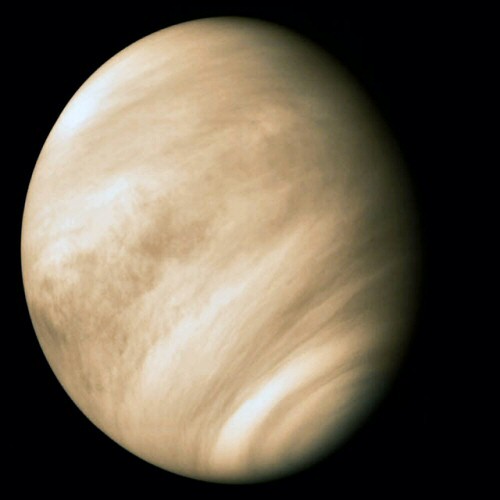
Venus
Venus means:
In astronomy mythology, Venus was the Roman goddess of love and beauty. In Greek, her name was Aphrodite.
How much would you weigh on Venus?
Because Venus and the Earth are almost the exact same size, you would weigh almost exactly the same on either planet. If you weighed 70 pounds (32 kg) on Earth, you would weigh 63 pounds (29 kg ) on Venus.
The Planet
The planet Venus has long been one of the most misunderstood of all the inner planets. Like the Earth, Venus has an atmosphere. However, Venus' atmosphere is far thicker than that of the Earth, making it difficult for modern science to penetrate. Interestingly, scientists have recently been able to peek through the thick clouds and get a few glimpses of the surface. There are numerous volcanoes and many mountains that appear misshapen.
There is much we still do not know about how this planet looks and what it is like. However, using special instruments and probes scientists have in recent years unlocked many of the secrets long hidden by this mysterious world. In the 1970s, the Soviet Union actually was able to land more than one probe on the surface of Venus. These scientific probes only lasted a few hours before they were destroyed by the intense heat of the planet. These probes were able to take several pictures and send them back to earth for scientists to study.
The Earth Has a Sister
Venus is in many ways Earth's sister planet. It is almost identical in size, chemistry, gravity and density as the Earth. In other words, Venus is made up of almost the exact same types of materials as the Earth and in about the same amounts. Venus has volcanoes, mountains and sand, just like Earth.
However, if they are twins, then Venus is the evil twin; she is the Earth gone wrong, very wrong. Venus is a deadly world where the surface temperature is hot enough to cook a meal in mere minutes. There is nowhere to hide from this ever present furnace. And with the atmosphere containing mostly carbon dioxide, it makes Venus a highly toxic place. No living thing would ever be able to survive on Venus.
Global Warming
In the early days of Venus' 4 billion year long life, it would have appeared very similar to the Earth. The two would have been almost identical. However, over a period of a few million years, forces on Venus caused it to take a very different course than the Earth.
Venus lies much closer to the Sun than does our planet. That single fact has caused an unstoppable chain of events that doomed Venus to its fiery existence. Owing to its closer proximity to the Sun, Venus' temperature should have been only slightly warmer than that of the Earth. But as the planet warmed, the water evaporated. This increase in water vapor in the atmosphere began a cycle of global warming that could not be stopped. Water vapor is a very effective greenhouse gas. (Greenhouse gas soaks up hot air and prevents it from escaping into space). The increase in water vapor caused the temperature to rise further, which caused more water to evaporate, causing the temperature to climb still further.
Today it is likely that all of Venus' water has evaporated into the atmosphere. This atmosphere effectively traps the Sun's energy causing the surface to burn much hotter than it naturally would. The temperatures on Venus can reach almost 900 degrees Fahrenheit (approx 482 degrees Celsius).
Venus is Dry
The Earth has a protective layer known as the Ozone Layer. This important shield protects the Earth from the Sun's ultraviolet radiation. Venus does not have an ozone layer. As a result, the ultraviolet radiation from the Sun finds its way directly into Venus' atmosphere. Over many billions of years this radiation has slowly broken down water molecules into hydrogen and oxygen. As a result, there is today very little water left on Venus.
Geography
Venus has many, many volcanoes. We don't know for sure, but it is possible that Venus has more volcanoes than any of the other planets in our Solar System. But unlike the volcanoes on Earth that can sometimes erupt in an explosive manner, the volcanoes on Venus are believed to erupt in a less violent way. In fact, it is believed that they don't erupt at all. Instead, it is thought that the lava just slowly flows out onto the surface.
Venus has a few mountainous areas along with extensive flat areas. There are craters and evidence that the surface long ago moved, much like the surface of the Earth moves today. But unlike the Earth's surface, there is no evidence that Venus has a tectonic plate system.
From West to East
If you somehow found a way to survive the scorching heat found on the surface of Venus, you would quickly notice something strange about the days. Aside from the fact that Venus rotates very slowly so that a day on Venus lasts more than 100 Earth days, Venus also rotates in the opposite direction as almost all the other planets.
Instead of the Sun rising in the east and setting in the west, the Sun on Venus would appear to rise in the west and set in the east.
Moons:
Venus has no moons.
Mercury
Mercury means:
In astronomy mythology, Mercury was the Roman version of the Greek god Hermes. He was the messenger for the other gods, and for this reason Mercury is often depicted in pictures with winged sandals. In addition to delivering messages, he was also the protector of travelers and merchants.
How much would you weigh on Mercury?
If you moved to Mercury you would not weigh as much as you do on Earth. Not because you would lose weight on the spaceship, but because Mercury is smaller, and so has less gravity. If you weigh 70 pounds (32 kg) on Earth, you would weigh only about 27 pounds (12 kg) on Mercury.
The Planet
The planet Mercury is the closest of the planets to the Sun. Because this planet lies so close to the Sun, and as a result somewhat near to Earth, it is visible to observers on Earth in the late evening or early morning sky. Because of this, Mercury has become a part of the mythology and legend of almost every culture throughout the history of the Earth.
This planet is often called a morning star. This is because Mercury shines brightly in the early morning just before the sun rises. It has also been called an evening star for the same reason. Mercury is often visible for a brief period of time just after the Sun sets.
Mercury is Heavy
Because of its proximity to the Sun, Mercury's evolution took a slightly different course than that of the other planets. As the Sun formed, it pushed much of the lighter gas and dust out of the inner Solar System, leaving behind only heavier elements. As a result, Mercury is made out of a large percentage of heavier elements, mainly iron. It is essentially a large metal ball of iron with a very thin silicate crust. Mercury's core makes up about 75% of the planet. Its thin mantle, or crust, is only about 300 to 400 miles thick (500 to 600 km). Next to Earth, Mercury is the second most dense planet in our Solar System.
Mercury Has Wrinkles
As Mercury's iron core cooled it contracted, or shrunk. This caused its rocky crust to become wrinkled. Scientists call these wrinkles Lobate Scarps. This scarps can be hundreds of miles long and even up to a mile high. Mercury's core has not cooled completely, however. Researcher recently found evidence that Mercury has a molten core.
Mercury is Scarred
The surface of the planet Mercury is covered with craters. These craters have been created by eons of accidental encounters with asteroids and comets. All celestial bodies within the Solar System are subject to these bombardments. However, many of the planets have the ability to heal themselves through natural geological processes.
Because Mercury's crust is so thick and hard, no volcanic activity can make its way through to the surface of the planet. Since this surface volcanic activity cannot happen, Mercury will forever retain its scars.
Mercury Has No Atmosphere
The planet Mercury is too small and has too little gravity to hold onto an atmosphere. Any gases released from the planet quickly escape into space. Also, Mercury is so close to the Sun that any atmosphere is quickly blown away by the Sun's solar winds. That means that there is almost no air on Mercury.
Temperature Extremes
Mercury is just a little bit larger than Earth's moon. The surface of Mercury that faces the Sun can reach about 800 degrees Fahrenheit. On the other hand, the temperature on the nighttime side can plummet to almost -300 degrees Fahrenheit. This is because Mercury has little to no atmosphere to help regulate temperature.
Time on Mercury
Because of its close location to the Sun, the planet Mercury has become tidally locked to the Sun, or nearly so. The tidal forces of the Sun have over eons of time slowed down the rotation of Mercury to match its revolution around the Sun. The result is that Mercury rotates very slowly. One day on Mercury is about 58-1/2 Earth days long. But while Mercury's days are very long, its revolution around the Sun is rather fast. Mercury can complete one orbit around the Sun in only 88 Earth days. That's just about 3 months here on Earth. This is why Mercury's name is so appropriate. In mythology, Mercury was a speedy messenger, just like the planet's speedy revolution around the Sun.
Moons:
Mercury has no moons.
Mercury's orbit is not a perfect circle like most of the other planets. It's actually egg-shaped. At times, Mercury's orbit brings it closer to the Sun than other times, while all the other planets that have circular orbits are always the same distance from the Sun.
The sun
Our Sun is not unique in the universe. It is a common middle-sized yellow star which scientists have named Sol, after the ancient Roman name. This is why our system of planets is called the Solar System. There are trillions of other stars in the universe just like it. Many of these stars have their own systems of planets, moons, asteroids, and comets.
The Sun was born in a vast cloud of gas and dust around 5 billion years ago. Indeed, these vast nebulae are the birth places of all stars. Over a period of many millions of years, this gas and dust began to fall into a common center under the force of its own gravity.
At the center, an ever growing body of mass was forming. As the matter fell inward, it generated a tremendous amount of heat and pressure. As it grew, the baby Sun became hotter and hotter. Eventually, when it reached a temperature of around 1 million degrees, its core ignited, causing it to begin nuclear fusion.
When this happened, the Sun began producing its own light, heat, and energy.
What is Thermonuclear Fusion?
Thermonuclear fusion is the process in which a star produce its light, heat, and energy. This happens at the core of the star. The core is superheated to millions of degrees. This heat travels towards the surface and radiates out into the universe. Through this thermonuclear process, stars "burn" a fuel known as hydrogen. The result is that they create another type of fuel known as helium. However, stars do not burn in the same way that a fire does, because stars are not on fire.
Convection
Heat rises, while cooler gas falls. Have you ever noticed that your basement is always much cooler than upstairs. The same laws of physics apply within stars. Because heat rises while cooler gases fall, the gas within a star is constantly rising and falling. This creates massive streams of circular motion within the star. This is called convection.
As the gases near the core of the Sun are heated, they begin to rise towards the surface. As they do so, they cool somewhat. Eventually they become cool enough that they begin to sink back down towards the core. It can take an atom millions of years to complete one complete cycle around a convection stream. As a result of this process, the temperature on the surface of the Sun is around 10,000 degrees Fahrenheit, which is much cooler than its superheated core.
Sun Spots
We don't often think of the Sun as having cooler areas on its surface. The Sun is far too hot
for an astronaut to ever visit, but there are areas which are slightly cooler than others. These areas are known as sun spots. Sun spots are still very hot. However, because they are slightly cooler than the rest of the surface of the Sun, they appear slightly darker in color. The gravitational forces in Sun spots are also stronger than the other hotter areas. Of course, you cannot look directly at the Sun to see these spots because you would damage your eyes. Astronomers have to use special telescopes with filters and other instruments to be able to see the cooler spots on the surface of the Sun.
Sun spots come and go on a regular basis. At times, there are very few, if any sun spots. At other times there are far more. They generally increase in intensity and then decrease over a period of 11 years. This 11 year cycle is known as the Saros Cycle. To learn more, click here.
Solar Flares
During periods of high solar activity, the Sun commonly releases massive amounts of gas and plasma into its atmosphere. These ejections are known as solar flares. Some solar flares can be truly massive, and contain impressive power. On occasion, these more powerful flares can even cause satellites orbiting the Earth to malfunction. They can also interact with Earth's magnetic field to create impressive and beautiful light shows known as the Northern and Southern lights. In the northern hemisphere, these lights are commonly known as the Aurora Borealis.
Solar Winds
As the Sun burns hydrogen at its core, it releases vast amounts of atomic particles, or pieces of atoms, into outer space. These atomic particles along with the Sun's radiation create a sort of wind, known as the solar wind.
This wind blows particles outward in all directions from the Sun. Even as you read this, there are atomic particles which are traveling from the Sun towards you. Often, particles pass right through your body without you ever realizing it.
Eventually this wind reaches out beyond the Solar System and begins to mix with the winds from other stars. The bubble around the Sun where the solar winds are still strong enough to blow outward is known as the heliosphere (note the Greek name Helios). The area of space where the winds are too weak to continue pushing outward and instead begin to mix with the winds of other stars is known as the interstellar medium.
The Sun's Family
The Sun is by far the largest object in the Solar System. 98% of all matter within the Solar System is found within the Sun. This means that all the planets, moons, asteroids, minor planets, comets, gas, and dust would all combine to make up only 2% of all the matter in the Solar System. The Sun is so large that the Earth could easily fit inside the Sun a million times.
Because the Sun is so large compared to everything else, it is easily able to hold on to the rest of the matter, causing everything else to orbit around it.
Loading...
Light from the Sun can reach the Earth in only 8 minutes! This is called the speed of light. The Sun is nearly 93 million miles (approx 145 million km) from
Tuesday, 20 December 2011
Our Cosmic Neighborhood
From our small world we have gazed upon the cosmic ocean for thousands of years. Ancient astronomers observed points of light that appeared to move among the stars. They called these objects "planets," meaning wanderers, and named them after Roman deities—Jupiter, king of the gods; Mars, the god of war; Mercury, messenger of the gods; Venus, the goddes of love and beauty, and Saturn, father of Jupiter and god of agriculture. The stargazers also observed comets with sparkling tails, and meteors or shooting stars apparently falling from the sky.
Since the invention of the telescope, three more planets have been discovered in our solar system: Uranus (1781), Neptune (1846), and, now downgraded to a dwarf planet, Pluto (1930). In addition, there are thousands of small bodies such as asteroids and comets. Most of the asteroids orbit in a region between the orbits of Mars and Jupiter, while the home of comets lies far beyond the orbit of Pluto, in the Oort Cloud.
The four planets closest to the sun—Mercury, Venus, Earth, and Mars—are called the terrestrial planets because they have solid rocky surfaces. The four large planets beyond the orbit of Mars—Jupiter, Saturn, Uranus, and Neptune—are called gas giants. Tiny, distant, Pluto has a solid but icier surface than the terrestrial planets.
Nearly every planet—and some of the moons—has an atmosphere. Earth's atmosphere is primarily nitrogen and oxygen. Venus has a thick atmosphere of carbon dioxide, with traces of poisonous gases such as sulfur dioxide. Mars's carbon dioxide atmosphere is extremely thin. Jupiter, Saturn, Uranus, and Neptune are primarily hydrogen and helium. When Pluto is near the sun, it has a thin atmosphere, but when Pluto travels to the outer regions of its orbit, the atmosphere freezes and collapses to the planet's surface. In that way, Pluto acts like a comet.
Moons, Rings, and Magnetospheres
There are 140 known natural satellites, also called moons, in orbit around the various planets in our solar system, ranging from bodies larger than our own moon to small pieces of debris.
From 1610 to 1977, Saturn was thought to be the only planet with rings. We now know that Jupiter, Uranus, and Neptune also have ring systems, although Saturn's is by far the largest. Particles in these ring systems range in size from dust to boulders to house-size, and may be rocky and/or icy.
Most of the planets also have magnetic fields, which extend into space and form a magnetosphere around each planet. These magnetospheres rotate with the planet, sweeping charged particles with them. The sun has a magnetic field, the heliosphere, which envelops our entire solar system.
Ancient astronomers believed that the Earth was the center of the universe, and that the sun and all the other stars revolved around the Earth. Copernicus proved that Earth and the other planets in our solar system orbit our sun. Little by little, we are charting the universe, and an obvious question arises: Are there other planets where life might exist? Only recently have astronomers had the tools to indirectly detect large planets around other stars in nearby solar systems.
—Text courtesy NASA/JPL
Monday, 19 December 2011
Our Solar System
The Solar System[a] consists of the Sun and the astronomical objects gravitationally bound in orbit around it, all of which formed from the collapse of a giant molecular cloud approximately 4.6 billion years ago. The vast majority of the system's mass (well over 99%) is in the Sun. Of the many objects that orbit the Sun, most of the mass is contained within eight relatively solitary planets[e] whose orbits are almost circular and lie within a nearly flat disc called the ecliptic plane. The four smaller inner planets, Mercury, Venus, Earth and Mars, also called the terrestrial planets, are primarily composed of rock and metal. The four outer planets, the gas giants, are substantially more massive than the terrestrials. The two largest, Jupiter and Saturn, are composed mainly of hydrogen and helium; the two outermost planets, Uranus and Neptune, are composed largely of ices, such as water, ammonia and methane, and are often referred to separately as "ice giants".
The Solar System is also home to a number of regions populated by smaller objects. The asteroid belt, which lies between Mars and Jupiter, is similar to the terrestrial planets as it is composed mainly of rock and metal. Beyond Neptune's orbit lie the Kuiper belt and scattered disc; linked populations of trans-Neptunian objects composed mostly of ices such as water, ammonia and methane. Within these populations, five individual objects, Ceres, Pluto, Haumea, Makemake and Eris, are recognized to be large enough to have been rounded by their own gravity, and are thus termed dwarf planets.[e] In addition to thousands of small bodies[e] in those two regions, various other small body populations, such as comets, centaurs and interplanetary dust, freely travel between regions.
Six of the planets and three of the dwarf planets are orbited by natural satellites,[b] usually termed "moons" after Earth's Moon. Each of the outer planets is encircled by planetary rings of dust and other particles.
The solar wind, a flow of plasma from the Sun, creates a bubble in the interstellar medium known as the heliosphere, which extends out to the edge of the scattered disc. The hypothetical Oort cloud, which acts as the source for long-period comets, may also exist at a distance roughly a thousand times further than the heliosphere.
The Solar System is located in the Milky Way galaxy, which contains about 200 stars
Our Solar System
Click On An Item To Learn
About It
Content on this page requires a newer version of Adobe Flash Player.
Our solar neighborhood is an exciting place. The Solar System is full of planets, moons, asteroids, comets, minor planets, and many other exciting objects. Learn about Io, the explosive moon that orbits the planet Jupiter, or explore the gigantic canyons and deserts on Mars.
What Is The Solar System?
The Solar System is made up of all the planets that orbit our Sun. In addition to planets, the Solar System also consists of moons, comets, asteroids, minor planets, and dust and gas.
Everything in the Solar System orbits or revolves around the Sun. The Sun contains around 98% of all the material in the Solar System. The larger an object is, the more gravity it has. Because the Sun is so large, its powerful gravity attracts all the other objects in the Solar System towards it. At the same time, these objects, which are moving very rapidly, try to fly away from the Sun, outward into the emptiness of outer space. The result of the planets trying to fly away, at the same time that the Sun is trying to pull them inward is that they become trapped half-way in between. Balanced between flying towards the Sun, and escaping into space, they spend eternity orbiting around their parent star.
How Did The Solar System form?
This is an important question, and one that is difficult for scientists to understand. After all, the creation of our Solar System took place billions of years before there were any people around to witness it. Our own evolution is tied closely to the evolution of the Solar System. Thus, without understanding from where the Solar System came from, it is difficult to comprehend how mankind came to be.
Scientists believe that the Solar System evolved from a giant cloud of dust and gas. They believe that this dust and gas began to collapse under the weight of its own gravity. As it did so, the matter contained within this could begin moving in a giant circle, much like the water in a drain moves around the center of the drain in a circle.
At the center of this spinning cloud, a small star began to form. This star grew larger and larger as it collected more and more of the dust and gas that collapsed into it.
Further away from the center of this mass where the star was forming, there were smaller clumps of dust and gas that were also collapsing. The star in the center eventually ignited forming our Sun, while the smaller clumps became the planets, minor planets, moons, comets, and asteroids.
A Great Storm
Once ignited, the Sun's powerful solar winds began to blow. These winds, which are made up of atomic particles being blown outward from the Sun, slowly pushed the remaining gas and dust out of the Solar System.
Content on this page requires a newer version of Adobe Flash Player.
With no more gas or dust, the planets, minor planets, moons, comets, and asteroids stopped growing. You may have noticed that the four inner planets are much smaller than the four outer planets. Why is that?
Because the inner planets are much closer to the Sun, they are located where the solar winds are stronger. As a result, the dust and gas from the inner Solar System was blown away much more quickly than it was from the outer Solar System. This gave the planets of the inner Solar System less time to grow.
Another important difference is that the outer planets are largely made of gas and water, while the inner planets are made up almost entirely of rock and dust. This is also a result of the solar winds. As the outer planets grew larger, their gravity had time to accumulate massive amounts of gas, water, as well as dust.
The Solar System Has Over 100 Worlds
It is true that there are only eight planets. However, the Solar System is made up of over 100 worlds that are every bit as fascinating. Some of these minor planets, and moons are actually larger than the planet Mercury!
Others, such as Io, have active volcanoes. Europa has a liquid water ocean, while Titan has lakes, rivers, and oceans of liquid Methane. You can read more about these amazing worlds by clicking here.
The Asteroid Belt, The Kuiper Belt, And The Oort Cloud
You have probably heard about the Asteroid Belt. This band of asteroids sits between the orbits of the planets Jupiter and Mars. It is made up of thousands of objects too small to be considered planets. Some of them no larger than a grain of dust, while others, like Eros can be more than 100 miles across. A few, like Ida, even have their own moons.
Further out, beyond the orbit of the minor planet Pluto, sits another belt known as the Kuiper Belt. Like the Asteroid Belt, the Kuiper Belt is also made up of thousands, possibly even millions of objects too small to be considered planets. A few of these objects, like Pluto, are large enough that their gravity has pulled them into a sphere shape.
These objects are made out of mostly frozen gas with small amounts of dust. They are often called dirty snowballs. However, you probably know them by their other name... comets.
Content on this page requires a newer version of Adobe Flash Player.
Every once in a while one of these comets will be thrown off of its orbit in the Kuiper Belt and hurled towards the inner Solar System where it slowly melts in a fantastic show of tail and light.
Beyond the Kuiper Belt sits a vast area known as the Oort Cloud. Here within this jumbled disorganized cloud live millions of additional comets. These comets do not orbit the Sun in a ring or belt. Instead, each one buzzes around in a completely random direction, and at extremely high velocities.
Beyond The Oort Cloud
The Sun's solar winds continue pushing outward until they finally begin to mix into the interstellar medium, becoming lost with the winds from other stars. This creates a sort of bubble called the Heliosphere. Scientists define the boundaries of the Solar System as being the border of the Heliosphere, or at the place where the solar winds from the Sun mix with the winds from other stars.
The Heliosphere extends out from the Sun to a distance of about 15 billion miles, which is more than 160 times further from the Sun than is the Earth.
Solar System Facts
Each page is full of fun and exciting facts about our Solar System. Take your time, and enjoy exploring our solar family.
Did you know that moons are also called satellites?
The Solar System is also home to a number of regions populated by smaller objects. The asteroid belt, which lies between Mars and Jupiter, is similar to the terrestrial planets as it is composed mainly of rock and metal. Beyond Neptune's orbit lie the Kuiper belt and scattered disc; linked populations of trans-Neptunian objects composed mostly of ices such as water, ammonia and methane. Within these populations, five individual objects, Ceres, Pluto, Haumea, Makemake and Eris, are recognized to be large enough to have been rounded by their own gravity, and are thus termed dwarf planets.[e] In addition to thousands of small bodies[e] in those two regions, various other small body populations, such as comets, centaurs and interplanetary dust, freely travel between regions.
Six of the planets and three of the dwarf planets are orbited by natural satellites,[b] usually termed "moons" after Earth's Moon. Each of the outer planets is encircled by planetary rings of dust and other particles.
The solar wind, a flow of plasma from the Sun, creates a bubble in the interstellar medium known as the heliosphere, which extends out to the edge of the scattered disc. The hypothetical Oort cloud, which acts as the source for long-period comets, may also exist at a distance roughly a thousand times further than the heliosphere.
The Solar System is located in the Milky Way galaxy, which contains about 200 stars
Our Solar System
Click On An Item To Learn
About It
Content on this page requires a newer version of Adobe Flash Player.
Our solar neighborhood is an exciting place. The Solar System is full of planets, moons, asteroids, comets, minor planets, and many other exciting objects. Learn about Io, the explosive moon that orbits the planet Jupiter, or explore the gigantic canyons and deserts on Mars.
What Is The Solar System?
The Solar System is made up of all the planets that orbit our Sun. In addition to planets, the Solar System also consists of moons, comets, asteroids, minor planets, and dust and gas.
Everything in the Solar System orbits or revolves around the Sun. The Sun contains around 98% of all the material in the Solar System. The larger an object is, the more gravity it has. Because the Sun is so large, its powerful gravity attracts all the other objects in the Solar System towards it. At the same time, these objects, which are moving very rapidly, try to fly away from the Sun, outward into the emptiness of outer space. The result of the planets trying to fly away, at the same time that the Sun is trying to pull them inward is that they become trapped half-way in between. Balanced between flying towards the Sun, and escaping into space, they spend eternity orbiting around their parent star.
How Did The Solar System form?
This is an important question, and one that is difficult for scientists to understand. After all, the creation of our Solar System took place billions of years before there were any people around to witness it. Our own evolution is tied closely to the evolution of the Solar System. Thus, without understanding from where the Solar System came from, it is difficult to comprehend how mankind came to be.
Scientists believe that the Solar System evolved from a giant cloud of dust and gas. They believe that this dust and gas began to collapse under the weight of its own gravity. As it did so, the matter contained within this could begin moving in a giant circle, much like the water in a drain moves around the center of the drain in a circle.
At the center of this spinning cloud, a small star began to form. This star grew larger and larger as it collected more and more of the dust and gas that collapsed into it.
Further away from the center of this mass where the star was forming, there were smaller clumps of dust and gas that were also collapsing. The star in the center eventually ignited forming our Sun, while the smaller clumps became the planets, minor planets, moons, comets, and asteroids.
A Great Storm
Once ignited, the Sun's powerful solar winds began to blow. These winds, which are made up of atomic particles being blown outward from the Sun, slowly pushed the remaining gas and dust out of the Solar System.
Content on this page requires a newer version of Adobe Flash Player.
With no more gas or dust, the planets, minor planets, moons, comets, and asteroids stopped growing. You may have noticed that the four inner planets are much smaller than the four outer planets. Why is that?
Because the inner planets are much closer to the Sun, they are located where the solar winds are stronger. As a result, the dust and gas from the inner Solar System was blown away much more quickly than it was from the outer Solar System. This gave the planets of the inner Solar System less time to grow.
Another important difference is that the outer planets are largely made of gas and water, while the inner planets are made up almost entirely of rock and dust. This is also a result of the solar winds. As the outer planets grew larger, their gravity had time to accumulate massive amounts of gas, water, as well as dust.
The Solar System Has Over 100 Worlds
It is true that there are only eight planets. However, the Solar System is made up of over 100 worlds that are every bit as fascinating. Some of these minor planets, and moons are actually larger than the planet Mercury!
Others, such as Io, have active volcanoes. Europa has a liquid water ocean, while Titan has lakes, rivers, and oceans of liquid Methane. You can read more about these amazing worlds by clicking here.
The Asteroid Belt, The Kuiper Belt, And The Oort Cloud
You have probably heard about the Asteroid Belt. This band of asteroids sits between the orbits of the planets Jupiter and Mars. It is made up of thousands of objects too small to be considered planets. Some of them no larger than a grain of dust, while others, like Eros can be more than 100 miles across. A few, like Ida, even have their own moons.
Further out, beyond the orbit of the minor planet Pluto, sits another belt known as the Kuiper Belt. Like the Asteroid Belt, the Kuiper Belt is also made up of thousands, possibly even millions of objects too small to be considered planets. A few of these objects, like Pluto, are large enough that their gravity has pulled them into a sphere shape.
These objects are made out of mostly frozen gas with small amounts of dust. They are often called dirty snowballs. However, you probably know them by their other name... comets.
Content on this page requires a newer version of Adobe Flash Player.
Every once in a while one of these comets will be thrown off of its orbit in the Kuiper Belt and hurled towards the inner Solar System where it slowly melts in a fantastic show of tail and light.
Beyond the Kuiper Belt sits a vast area known as the Oort Cloud. Here within this jumbled disorganized cloud live millions of additional comets. These comets do not orbit the Sun in a ring or belt. Instead, each one buzzes around in a completely random direction, and at extremely high velocities.
Beyond The Oort Cloud
The Sun's solar winds continue pushing outward until they finally begin to mix into the interstellar medium, becoming lost with the winds from other stars. This creates a sort of bubble called the Heliosphere. Scientists define the boundaries of the Solar System as being the border of the Heliosphere, or at the place where the solar winds from the Sun mix with the winds from other stars.
The Heliosphere extends out from the Sun to a distance of about 15 billion miles, which is more than 160 times further from the Sun than is the Earth.
Solar System Facts
Each page is full of fun and exciting facts about our Solar System. Take your time, and enjoy exploring our solar family.
Did you know that moons are also called satellites?
Subscribe to:
Posts (Atom)